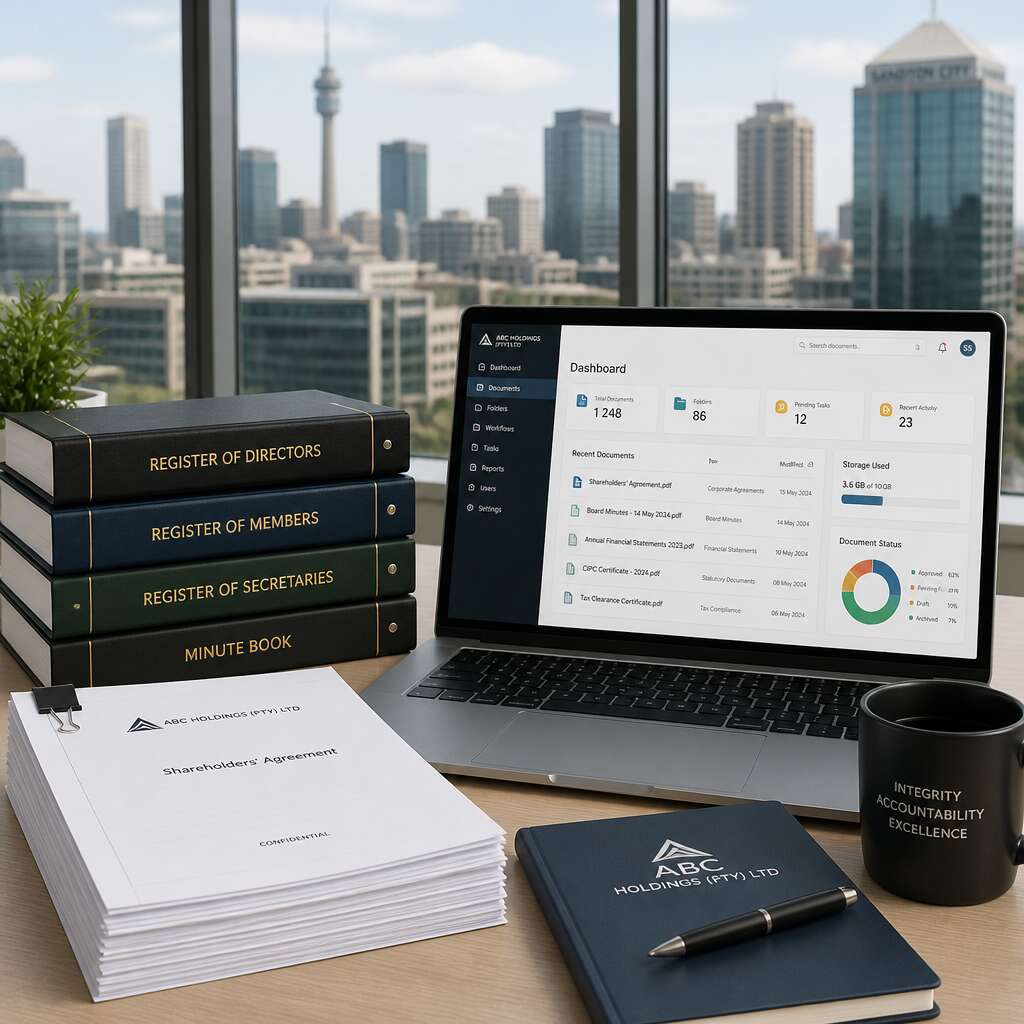
The Legal Framework Governing Corporate Records in South Africa
Statutory Obligations Under the Companies Act 71 of 2008
A single missing ledger can trigger criminal liability under the Companies Act 71 of 2008. The Act requires every company to keep accurate accounting records, including transactions, assets and liabilities. These records must be preserved for seven years.
The maintenance of company records South Africa demands more than storage, I assure you. Directors must also keep minutes, board resolutions and share registers.
- Annual financial statements
- Beneficial interest registers
Each item supports compliance during regulatory audits.
Non compliance carries fines or imprisonment. The Act binds holding companies and subsidiaries equally. Every company must systematically update these records to shield directors from personal liability.
The Role of the Companies and Intellectual Property Commission (CIPC)
I have seen directors discover the CIPC’s true reach only after a compliance notice arrives. The legal framework governing corporate records is precise, and the Companies Act 71 of 2008 delegates substantial enforcement power to the Companies and Intellectual Property Commission (CIPC).
In practice, maintenance of company records South Africa extends beyond annual returns. The CIPC cross references those filings against its own databases, checking director details, financial statements, and beneficial ownership registers. A single mismatch can halt your filing. The commission’s enforcement toolkit includes:
- Compliance notices demanding corrective action within a fixed period
- Administrative fines for late or inaccurate submissions
- Referral for criminal prosecution when breaches are deliberate
Repeated failures in maintenance of company records South Africa escalate to director disqualification. The CIPC also maintains the public register, so your records remain visible to creditors and competitors.
Prescribed Documents Every South African Company Must Hold
Most directors underestimate how many documents the law actually requires. The Companies Act 71 of 2008 compels every South African company to hold a defined set of records beyond the certificate of incorporation. These include:
- Memorandum of incorporation and subsequent amendments
- Minutes of shareholder and board meetings
- Register of directors and prescribed officers
- Accounting records and financial statements
- Beneficial ownership register
Each document carries distinct legal weight. The register of directors, for instance, must reflect appointments and resignations within prescribed timeframes. The beneficial ownership register has become especially critical following the General Laws (Anti-Money Laundering) Amendment Act. Proper maintenance of company records South Africa requires that every document remain accurate and accessible. The CIPC can demand any of them during a compliance review, and incomplete files can stall your filing entirely. Neglecting the maintenance of company records South Africa is the fastest route to a compliance notice. I have yet to meet a director who enjoyed that experience.
Penalties and Legal Consequences for Non-Compliance
Fines of up to ZAR 1 million and a decade behind bars aren’t hyperbole. The Companies Act 71 of 2008 makes the maintenance of company records South Africa a statutory duty, not a suggestion. When records go missing, the burden falls on the director to explain why. I’ve watched directors scramble to reconstruct shredded minutes during audits, and it never ends well. The CIPC doesn’t need to prove intent to issue a compliance notice, but courts can impose criminal sanctions for deliberate destruction.
Consequences awaiting those who fall short include:
– Compliance notices with tight deadlines
– Administrative fines that escalate monthly
– Director disqualification orders
– Criminal prosecution for fraud or forgery
Recent enforcement actions show the CIPC is auditing beneficial ownership registers with fresh urgency. The maintenance of company records South Africa demands more than storing paper in a drawer. It requires a working system that keeps every document current and retrievable within hours.
Essential Records Every South African Company Must Retain
Financial Records and Annual Financial Statements
Financial records determine whether a company passes a compliance audit. In South Africa, the Companies Act requires that these records accurately explain the company’s financial position. The maintenance of company records South Africa is a legal duty that carries personal consequences for directors who fail to comply.
Annual financial statements serve a different but equally important purpose. They consolidate a full year of transactions into an intelligible overview. Financial records show the detail. Statements show the direction. Both must be kept for at least seven years.
A compliant filing system typically includes:
- Bank statements
- Invoices and receipts
- Payroll and VAT records
- Loan agreements
Without these, a company cannot prepare accurate annual financial statements, and auditors will struggle to verify anything. In my experience, that is where compliance problems begin.
Share Register and Beneficial Ownership Information
Most directors never open their share register until a dispute erupts. That is a costly mistake. A share register records names, addresses, and holdings of every shareholder. It must also capture transfers, repurchases, and cancellations.
In South Africa, beneficial ownership information goes further, identifying the natural persons who ultimately own or control the company. The maintenance of company records South Africa requires both sets of data to be accurate and current. The Companies and Intellectual Property Commission now cross-checks this information against other filings.
I have watched compliance officers scramble when a single share transfer goes undocumented. Do not let that be you.
Minutes of Board and Shareholder Meetings
Minutes capture every decision your board makes. Without them, you have nothing but handshakes and hearsay. In my experience, directors often treat minutes as an afterthought, scribbled notes that barely capture the discussion. That approach fails you during an audit or a shareholder dispute.
Proper minutes must record attendance, resolutions, declarations of interest, and voting outcomes. They should reflect the substance of deliberation, with voting outcomes recorded alongside the reasoning. The Companies Act requires minutes to be kept within specified timeframes, and the maintenance of company records South Africa makes these documents central to proving good governance. Without disciplined minute keeping, the maintenance of company records South Africa becomes a reactive exercise rather than a routine safeguard.
A well-structured minute book can include:
– Written resolutions signed by all shareholders
– Notices of meeting sent within the required periods
– Proxy forms and attendance registers
When minutes are missing, directors cannot prove they acted lawfully.
Statutory Registers for Directors and Auditors
Statutory registers for directors and auditors rarely receive the attention they deserve. I often see them reduced to a single page with outdated entries. The Companies Act expects far more! The directors’ register must track appointments, resignations, and every declared interest. The auditor register must document appointment dates, tenure, and any rotation or removal.
Maintenance of company records South Africa depends on these registers being current and available for inspection. A register that fails to reflect a resignation can cause significant damage during due diligence.
- Directors’ full names and identity numbers
- Dates of appointment and termination
- Auditor appointment and reappointment history
- Declarations of interest
Auditors rely on these records to understand the governance landscape. For a UK investor assessing a South African subsidiary, a missing register signals deeper problems in the maintenance of company records South Africa.
Material Contracts and Agreements
Most directors can recall their biggest deals. Far fewer can put their hands on the signed paperwork. That gap becomes painfully obvious during due diligence, when a potential investor asks to see a contract and receives a blank stare. Maintenance of company records South Africa is about closing that gap.
Material contracts and agreements are the reference points for mergers, acquisitions, and disputes. Your company must retain:
– Loan and financing agreements
– Supplier and customer contracts above a set threshold
– Property leases and asset purchase agreements
– Shareholder and joint venture agreements
– Guarantees and indemnities
Each file must include annexures and amendments. A contract signed in 2015 with a 2019 addendum tells a complete story only if both documents sit together. That is the standard maintenance of company records South Africa demands.
Employment and Tax-Related Records (PAYE, UIF, SDL)
The South African Revenue Service audits thousands of payrolls each year. A single missing IRP5 can trigger a full reassessment. That is why maintenance of company records South Africa extends to payroll documentation.
- PAYE monthly and reconciliation submissions
- UIF declarations and contribution statements
- SDL levy returns and exemption documents
- Employee tax certificates (IRP5/IT3)
Retention periods vary, but most tax records require a five year archive. A routine labour audit can demand these files with little notice. Solid recordkeeping keeps your business ready.
Minimum Retention Periods for Company Records in South Africa
Retention Timeframes for Financial Documents
Seven years feels like a lifetime until an old invoice resurfaces. Under the Companies Act 71 of 2008, financial records must be preserved for at least seven years from the date of each transaction. That means every bank statement, supplier contract, and tax assessment has its own countdown timer. The maintenance of company records South Africa becomes a juggling act when you consider that SARS requires only five years for supporting documents. Always default to the longer period.
Which documents demand your attention?
- Annual financial statements: 7 years.
- Sales invoices and receipts: 7 years.
- Bank statements and cheques: 7 years.
- Tax returns and assessments: 5 years.
I have watched companies lose disputes over missing paperwork. A claim can arrive after six years, and the absence of a single contract leaves you defenceless. Record keeping is not a chore. It is a survival mechanism.
Corporate Governance Records and Their Timelines
A board minute from 2012 can decide a dispute in 2032. Corporate governance records do not expire like financial transactions. The Companies Act 71 of 2008 prescribes minimum periods, but the wise archivist keeps these documents for the entire existence of the company plus a buffer.
The maintenance of company records South Africa hinges on understanding that governance records demand permanent custody. While financial records follow a seven year cycle, board minutes, shareholder resolutions, and director declarations form the basis of every decision made.
- Board and committee minutes: permanent.
- Shareholder resolutions and special notices: permanent.
- Director appointments and removals: 7 years after termination.
- Proxy forms and voting tallies: 7 years.
Discarding a resolution after six years is a bet against the future. Regulators and courts rarely announce when they need a governance record. Hold them for decades, not because the statute demands it, but because the record cannot be recreated.
Prescription Periods for Employee and Tax Records
The Prescription Act 68 of 1969 gives creditors three years to claim a debt. SARS, however, can reach back five years for routine audits and seven if fraud is flagged. That mismatch catches many companies off guard. For anyone handling the maintenance of company records South Africa, this is a practical headache, since the minimum retention periods for employee and tax records are not a single number.
The Basic Conditions of Employment Act demands that wage records, PAYE deductions, and UIF contributions stay on file for three years. But the prescription clock on unpaid wages also runs for three years, meaning a former employee can sue after the legal minimum has expired. I usually advise clients to keep employment records for at least five years, and SARS’s own documentation rules align with that for income tax and VAT. The periods break down like this:
- PAYE, UIF, and SDL records: 3 years under the BCEA, 5 years under tax law.
- Income tax returns and supporting documents: 5 years, or 7 if the return was fraudulent.
- VAT records, including invoices and credit notes: 5 years.
The periods run concurrently, not sequentially. One record can serve multiple obligations, each with its own expiry date, and the longest applicable period should govern. The maintenance of company records South Africa demands a retention schedule built around prescription risk, not around the shortest statutory minimum. Keeping records for seven years removes most of that risk without much extra effort.
Secure Destruction and Archiving Best Practices
Most companies assume that once a statutory minimum passes, the paperwork can go to the shredder. That assumption is expensive. The Companies Act requires some records for seven years, but contract claims can extend exposure for years longer. The safest approach to the maintenance of company records South Africa is to classify by risk, not by the easiest expiry date.
Secure destruction matters as much as storage. Shredding alone is not enough when records contain personal information. You need a certified destruction certificate and a log of what was destroyed, when, and under whose authority.
A practical archiving schedule:
- Keep permanent records such as minutes, share registers, and lodged documents indefinitely.
- Retain contracts for six years after termination.
- Review digital archives quarterly to flag records that are eligible for secure disposal.
The maintenance of company records South Africa becomes manageable once you commit to a schedule and follow it. What you destroy carefully matters as much as what you keep.
Digital Versus Physical Record-Keeping: Best Practices
Electronic Record-Keeping Under the Electronic Transactions Act
Nearly 70% of auditors now expect electronic records as the primary mode of record retention. For any business managing the maintenance of company records South Africa, this shift demands clarity on the Electronic Transactions Act.
That Act grants digital files the same legal weight as paper, provided you preserve integrity and accessibility! A scanned board resolution or a PDF of a signed contract holds up in dispute if you can prove it hasn’t been altered since creation. So, adopt these practices:
- Use immutable formats like PDF/A to prevent tampering.
- Log every access and modification with a clear audit trail.
- Mirror backups across two separate geographic locations.
Physical originals still matter for notarised documents and wet-ink signatures. However, the daily operational burden of the maintenance of company records South Africa now rests on electronic systems. I’ve seen how aligning your storage habits with the Act reduces risk without sacrificing the ease of a well-kept archive.
Cloud Storage Solutions for Small and Large Enterprises
Cloud storage has reshaped how company secretaries approach the maintenance of company records South Africa. A hybrid system often works best: keep physical files for original signed deeds and rely on digital scans for everyday retrieval.
Small enterprises can manage with a single encrypted cloud drive that offers version history. Large enterprises, by contrast, require hierarchical access controls and automated retention policies. The real divide is operational, not technological.
- Verify your cloud provider’s data residency for South African records
- Schedule quarterly integrity checks on archived files
- Assign custody responsibilities explicitly
I have seen firms lose credibility simply because their storage lacked a clear chain of custody. Choose vendors that support immutability and audit logging, then test retrieval speeds regularly!
Backup and Disaster Recovery Strategies
A locked filing cabinet won’t survive a burst pipe, but a hard drive can fail silently. The maintenance of company records South Africa demands a dual approach. I have seen companies lose a decade of board minutes because nobody verified whether the backup actually restored. Physical originals belong in fireproof, watertight storage. Digital copies belong in encrypted systems with version history. The two are complementary, not competing. You need a simple rule for backup and disaster recovery:
- Keep three copies of every share register and resolution
- Use two different storage media
- Store one copy in a separate geographic location
Test restoration quarterly. Restore a random file to a test folder. Keep a printed inventory of all records and their locations. For the maintenance of company records South Africa, the goal is reproducibility, not perfection. If you can reconstruct every statutory document within 24 hours, you have a working strategy.
Document Management Systems and Automation Tools
Paper and pixels each have a role in the maintenance of company records South Africa. A shared drive with automated version control beats a binder of signed originals for daily access, but the registry copy still holds legal weight. The best document management systems act as a central repository. They apply retention schedules, restrict editing, and log every access. Automation tools go further! They extract metadata from scanned resolutions, file them under the correct company registration number, and flag missing signatures.
- Every file name follows a standard pattern (date, document type, version).
- Access permissions map to Companies Act officer roles.
- Audit trails record who viewed or amended each record.
Even with automation, physical originals remain necessary for notarised contracts and stamped resolutions. Knowing which records require the hard copy and which exist only digitally saves time when CIPC requests a document for inspection.
Safeguarding Confidentiality and POPIA Compliance
Every year, POPIA breaches trace back to a forgotten filing cabinet or an unlocked spreadsheet. The maintenance of company records South Africa demands equal vigilance over paper and pixels. Physical records need restricted access, logged movement, and secure storage. Digital records require encryption, access controls, and audit trails.
I’ve learned that a hybrid approach works best! Safeguarding confidentiality means knowing where each record lives and who can touch it. POPIA obliges companies to protect personal information regardless of format. So apply the same rigor to both. You cannot assume a printed resolution is safe behind a locked door, nor trust a cloud file because nobody shares the link.
Common Record-Keeping Pitfalls and How to Avoid Them
Failing to Update Beneficial Ownership Registers
The beneficial ownership register remains one of the most neglected documents in the maintenance of company records South Africa. Companies frequently file initial details with CIPC, then overlook updates when shareholdings shift or new beneficial owners emerge. That oversight creates a mismatch between filed information and the actual ownership structure.
Directors often assume the register only matters during annual submissions. That assumption leads to compliance gaps. The Companies Act demands continuous updates within defined timeframes. A single undisclosed share acquisition can render the entire register inaccurate.
Common errors include:
– Recording only direct shareholders, missing indirect beneficial owners
– Failing to document the nature and extent of beneficial interest
– Ignoring changes triggered by trust arrangements or nominee structures
– Not verifying the accuracy of shareholder-provided information
Each error compounds the risk of penalties and undermines the maintenance of company records South Africa.
Incomplete or Outdated Shareholder Records
A share register that lags reality is a silent liability. Many South African companies treat shareholder records as a once a year exercise, which invites errors that surface during due diligence or dispute resolution.
Incomplete records often stem from haphazard capture of share transfers, allotments, or buybacks. When directors fail to record the date of transfer or the consideration paid, the register loses its evidentiary value. Common omissions include:
- Share transfer dates and counterparty details
- Certificates issued or cancelled
- Calls on shares or payment schedules
These gaps undermine the maintenance of company records South Africa. A disciplined approach, such as updating the register within seven days of any transaction, keeps the document reliable.
Overlooking CIPC Annual Return Submissions
Each year, thousands of South African companies treat the CIPC annual return as an afterthought. That single document is the price of keeping your company in good standing, and missing it brings fines and compliance headaches. The annual return submission confirms that your registered details, directors, and addresses reflect reality. Overlooking it pushes the maintenance of company records South Africa into a reactive mode, where you scramble to restore status rather than manage records calmly. The knock-on effects are concrete:
- Your company is marked as delinquent and removed from the active register.
- You lose access to essential CIPC services, including name changes and director updates.
- Late penalties accrue monthly until the submission is completed.
Set a calendar alert for the anniversary of incorporation and reconcile your records before filing. That discipline turns the annual return into a simple check.
Mixing Personal and Business Documents
Personal affairs mixed with business paperwork create the most disorganised records a South African company can hold! A mortgage statement tucked into the company file or a supplier invoice buried under private email printouts seems harmless until inspection time. Then the maintenance of company records South Africa becomes unnecessarily difficult.
- Company receipts placed in personal wallets or home drawers
- Director loan accounts recorded informally without supporting documents
- Business communication sent from personal phone numbers and email addresses
Each instance mixes the director’s personal affairs with the entity’s affairs. The Companies Act treats the company as a distinct person, and sloppy filing undermines that distinction. Clean maintenance of company records South Africa requires separate storage, separate accounts, and separate habits. Verification then becomes straightforward.
Poor File Naming and Version Control Issues
Nothing undermines a clean filing system faster than a file labelled ‘final_2’ or ‘updated copy’. You open it to find an outdated budget, and your statutory submission now rests on guesswork. I have seen directors waste hours reconciling versions that should never have coexisted!
- Date stamps placed at the end of filenames, forcing constant scrolling
- Initials added without explanation, like ‘SJ_revisions’
- Folders containing both scanned originals and edited copies without distinction
Version control failures are not a minor inconvenience. They create legal exposure when an outdated document gets submitted. The maintenance of company records South Africa depends entirely on distinguishing the current file from obsolete ones.




0 Comments